IKEA, the company’s name is derived out its four letters
that are initials for Ingvar Kamprad who grew up in a small farm;
Elmtaryd in the parish of Agunnaryd in Smaland situated in Sweden. The company
is the world's largest furniture retailer. In Småland, although the soil
is thin and poor, the people have a reputation for working hard, living
frugally and making the most out of limited resources. Ingvar as a small boy always
dreamt big and had very strong business acumen. He applied his experience and In
1943 when Ingvar was all of 17 years, the first commercial business began in
the name of IKEA, originally a mail-order business selling pencils, postcards,
and other merchandise.
It is only in 1948 that Furniture was introduced in
the IKEA business as an addition to the general merchandise. This was a
success at the onset and Ingvar Kamprad started exploring novel solutions like
furniture design, self-assembly and advertising.
By 1951, the first annual catalogue of IKEA furniture was
published in Sweden. IKEA published 212 million catalogues in 2012, in twenty
languages and sixty-one editions. It is measured to be the most
important marketing instrument of the retail giant, consuming 70% of the
company's annual marketing budget.
Two years later in 1953, the first of IKEA showroom’s opened
in Almhult where the customers could experience and see the products and then
order them. This gave Ingvar an opportunity to meet his customers and learn
from them.
The IKEA business started designing its own furniture by
1955 and with time the flat packs and self-assembly became part of the IKEA
concept. The first fully fledged store of IKEA opened in 1958 in Almhult. There
was scepticism attached around the idea of people travelling long distance to a
small village in the deep forest to buy furniture. But, a visit to IKEA store
became a concept that is prevalent till today. It became a day out for the
whole family where one could buy furniture and need for opportunities like self
serve restaurant and supervised children’s playroom were created. All IKEA
stores are located outside the main towns.
A revolution was created by Ingvar Kamprad whereby he tried
to influence both the factories and customers. He offered customers products at
low price with good design and function and offered the factories large orders.
Orders of large size meant low purchasing price thus enabling low sales price,
more customers and larger sales volumes.
The IKEA business is organised into four divisions, with the
Franchise Division as the most vital.
The Franchise Division with Inter IKEA Systems B.V.,
the proprietor of the IKEA Concept, franchises systems, systemizes and
solutions to franchisees across the globe for marketing and sale of IKEA
products under the IKEA trademarks. The division has complete accountability to
safeguard the constant success of the IKEA Concept, so as to benefit the many
people over generations. Inter IKEA Systems B.V. certifies that IKEA Concept
know-how is continuously developed, transferred, and made obtainable to all
IKEA franchisees.
The Retail Centre Division – Inter IKEA Centre Group
– expands and administers retail places anchored by IKEA stores. The division
attempts to produce exclusive retail and entertainment destinations in which
the IKEA stores and tenants profit from the harmony formed by their shared
site, which eventually adds to the customers’ shopping experience.
The Property Division attempts to generate long term
worth through property investments. The keystone of the process is
administration of portfolio properties and development of commercial real
estate.
The Finance Division comprises of investment
activities as well as treasury management.
The company is known for its contemporary architectural
designs on different kinds of appliances and furniture, often connected with a
simplified eco-friendly interior design. The firm is famous for the attention
it gives to cost control, operational details and continuous product
development, permitting it to lower its prices by an average of two to three
percent over the decade to 2010, whilst progressing its global expansion plans.
The world's five largest IKEA stores are:
1.
Stockholm Kungens Kurva, Sweden: 55,200 m2
2.
Shanghai, China: 49,400 m2
3.
Shenyang, China: 47,000 m2
4.
Tianjin, China: 45,736 m2
5.
Berlin Lichtenberg, Germany: 45,000 m2
On October 2012, IKEA clocked 338 stores in 38 countries. On
February 17, 2011, it declared its plans for a wind farm in Dalarna County,
Sweden, promoting the furniture giant's aim of operating on 100 percent
renewable energy. By mid-August 2012, the company proclaimed that it will
launch a chain of 100 budget hotels in Europe but, unlike its small number of
existing hotels in Scandinavia, the chain will neither carry the IKEA name nor
would they use IKEA furniture and furnishings.

The vast majority of IKEA stores are located outside the
main city, primarily because of land cost and traffic access. IKEA stores are typically
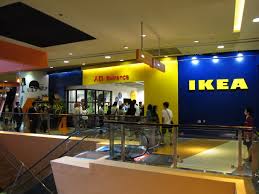
very huge blue buildings with yellow accents and few windows. They are usually planned
in a one-way layout, leading customers counter clockwise along what IKEA calls
"the long natural way" planned to push the customer to observe the
store in its totality. Newer IKEA stores, utilizes glass, both for aesthetics
and functionality. Skylights are also now widespread in the self-serve
warehouses; natural lighting decreases energy costs, develops worker’s confidence
and gives a superior notion of the product.

The layout includes of a series which involves first going
through furniture showrooms making note of particular items. The consumer then
gathers a shopping cart and carries on to an open-shelf "Market Hall"
warehouse for minor items, then visiting the "Self Serve" furniture
warehouse to accumulate formerly noted showroom products in ‘flat pack’ form. Occasionally,
they are directed to gather products from an outer warehouse on the same site
or at a site close by. At length, customers pay for their products at a cash
register.
Rather selling pre-assembled products, most of IKEA's
furniture is intended to be self-assembled. The company asserts that this aids
in reducing costs and use of packaging by not shipping it by air; the size of a
bookcase, for instance, is significantly less if it is shipped unassembled
rather than assembled.

Although the IKEA products and furniture are planned in
Sweden, they are mainly manufactured in developing countries to cut the costs.
With suppliers in 50 countries, almost ⅔ of purchasing is done from Europe and
about ⅓ from Asia.
IKEA products are recognized by single word names. Ingvar
Kamprad, who is dyslexic in nature realised that naming the furniture with
proper names and words, rather than a product code, made the names easier to
memorize. Most of the names are Scandinavian in origin. For example:
1.
Upholstered furniture, coffee tables, rattan
furniture, bookshelves, media storage, doorknobs: Swedish placenames (for
example: Klippan)
2.
Beds, wardrobes, hall furniture:
Norwegian place names
3.
Dining tables and chairs: Finnish place
names
4.
Bookcase ranges: Occupations
5.
Bathroom articles: Scandinavian lakes,
rivers and bays
6.
Kitchens: grammatical terms, sometimes
also other names
7.
Children's items: mammals, birds,
adjectives
Today, the IKEA trademark stands for the leading home
furnishings brand in the
world with 338 stores in 40 countries and close to 154,000 co-workers. Essential
activities such as eating, sleeping, storing items and socialising form a
demand for furniture and practical products that answer necessary human needs.
Furthermore, the large mainstreams of people have inadequate budgets and
restricted space in their homes.
The IKEA product assortment meets these requirements by
offering a wide assortment of well- designed, functional home furnishing
products at prices so low that as many people as probable will be able to
afford them. The IKEA variety comprises of products for every division of the
home. IKEA designers start the design process with a practical need and a price
tag, to secure the lowest possible price. IKEA designers are forever looking
for new ways to develop people’s lives - without emptying their wallets. IKEA
customers also add in keeping prices low. They choose and pick up the products
themselves, transport them home and then assemble them themselves.
The IKEA store is where the IKEA range comes to life.
Visitors are encouraged to take their time and get comfy with IKEA home
furnishing solutions and products in practical room situations and real-life
homes.
To sit, lie down, open and close drawers. To compare styles. Compare prices.
And
imagine the possibilities!
The IKEA Concept relies on customers to select, collect,
transport and assemble IKEA products themselves. All products in the store carry
price and product information that is visibly marked on large, easy-to-read
tags. This makes it simple for visitors to serve themselves. There are knowledgeable
co-workers existing at IKEA for customers when needed. The aim is to make the
IKEA experience and enjoyable one for the whole family. If the kids do not want
to shop, they can play in the supervised play area.
During the year 2012, more than 776 million visits were made
to IKEA stores across the globe. And the aspiration to offer home furnishing
solutions that are applicable for diverse markets around the world carries on
to drawing people to the stores. It has 9,479,500 square metres of retail
space. There have been 5,745,000 of ‘IKEA catalogue’ application downloads.
There has been a sales turnover of 27.5 billion Euros in 2012. The IKEA website
consists of about 12,000 products and is the closest illustration of the entire
IKEA range. It had a total of 1.1 billion hits in the same year. They browse
the IKEA range from the comfort of home and plan their next trip to the IKEA
store.


.JPG)
